IoT Sensor Market Poised for Strong Expansion with Sustained Growth Through 2035
IoT Sensor Market: The IoT Sensor Market is growing rapidly as connected sensors enable real-time monitoring,
Press Release Disclaimer: This is a press release distributed through the XPR Media network. It has not been independently verified by our newsroom.

NEW YORK,, NY, UNITED STATES, September 18, 2026 /EINPresswire.com/ — ➤ Market Overview
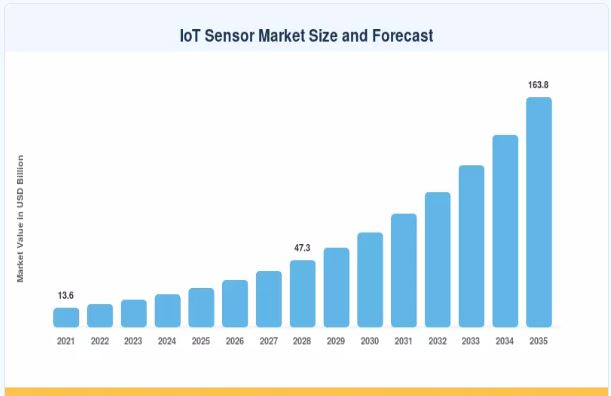
The IoT Sensor Market reached USD 27.8 billion in 2025 and enters the forecast window at USD 33.2 billion in 2026, climbing to USD 163.8 billion by 2035 at a 19.4% CAGR. This expansion reflects the growing dependence of connected devices, industrial automation, smart infrastructure, and healthcare monitoring on networked sensing hardware across industries.
Asia-Pacific commanded 38.0% of the IoT Sensor Market in 2025, supported by concentrated component manufacturing capacity and national digitalization mandates such as China’s action plan for high-quality IoT industry development. Governments and manufacturers are scaling factory automation, municipal infrastructure, and domestic semiconductor production to meet rising sensing demand.
North America ranks second with a 29.5% share in 2025, driven by industrial retrofit programs and reimbursed remote patient monitoring. Businesses are increasingly instrumenting existing machinery and facilities with wireless sensing nodes to reduce downtime and strengthen predictive maintenance capabilities without replacing entire production lines.
The Middle East & Africa is advancing at a 21.8% CAGR across the forecast period, the fastest of any region, as Gulf infrastructure programs instrument water, power, and transport networks from a comparatively small base. Sovereign digital strategies and giga-project buildouts are creating substantial opportunities for sensor suppliers throughout the region.
Download Sample Pages of Research Overview –
https://www.marketresearchfuture.com/sample_request/4399
➤ IoT Sensor Industry Landscape
IoT sensors are electronic sensing devices that measure physical parameters such as temperature, pressure, motion, humidity, gas concentration, and optical conditions, then transmit that data over wired or wireless networks to gateways, edge processors, or cloud platforms for analysis and action. Instead of relying on manual inspection or standalone instrumentation, organizations increasingly deploy connected sensing nodes that provide continuous, real-time visibility into equipment and environmental conditions.
The shift away from legacy instrumentation is strengthening demand across this category. Hard-wired transmitters, manual dataloggers, and periodic inspection rounds are giving way to battery-powered nodes with onboard signal conditioning, cryptographic identity, and multi-year field life. Advances in low-power wide-area networking and cellular standards are narrowing the cost gap between proprietary radios and standardized connectivity, expanding the range of economically viable deployments.
The Smart City Market is a relevant topical authority keyword because municipal infrastructure programs increasingly depend on dense networks of IoT sensors to monitor traffic, utilities, public safety, and environmental conditions in real time. Sensing hardware allows city governments to collect the granular data needed to operate water distribution, energy grids, and transportation systems more efficiently.
The connection between smart city programs and the IoT Sensor Market demonstrates how sensing infrastructure is becoming foundational to urban digital transformation. As municipalities deploy connected infrastructure, they require sensors capable of surviving outdoor conditions, communicating over wide-area networks, and operating for years without maintenance. These requirements create sustained opportunities for sensor manufacturers and system integrators across public-sector and commercial-infrastructure projects alike.
➤ Key Growth Drivers
The rapid proliferation of connected devices remains a major growth driver for the IoT Sensor Market. Enterprises, utilities, and consumers are deploying networked sensing hardware across manufacturing lines, vehicles, buildings, and wearable devices to gain real-time visibility into operations. This proliferation is reinforced by continuous declines in microelectromechanical systems (MEMS) fabrication costs, which are expanding the addressable base of economically viable sensing applications.
Industrial automation and predictive maintenance are another significant factor supporting industry expansion. Plant operators are increasingly retrofitting existing machinery with vibration, thermal, and acoustic sensors rather than replacing entire equipment lines, since wireless nodes can be installed without the cost of new conduit or wiring. This retrofit economics gap is one of the strongest demand pulls across discrete and process manufacturing industries alike.
➤ Industrial Automation and Predictive Maintenance
Predictive maintenance adoption is creating substantial opportunities because unplanned downtime carries a measurable and often severe cost across manufacturing, energy, and utility operations. Vibration analysis, thermal imaging, and acoustic monitoring sensors allow operators to detect equipment degradation before failure occurs, extending asset life while reducing unplanned outages.
Connectivity improvements are also broadening deployment feasibility. Low-power wide-area network technologies and reduced-capability cellular standards are cutting module costs and extending battery life, allowing operators to instrument remote or hard-to-wire equipment that was previously uneconomical to monitor. Cloud-connected sensing platforms can simplify these operations through unified dashboards, automated alerts, and centralized fleet management across dispersed industrial sites.
➤ Artificial Intelligence and Edge Intelligence
Artificial intelligence and on-device inference are transforming IoT sensing by enabling nodes to identify anomalies, forecast maintenance needs, and reduce the volume of data transmitted to the cloud. Microcontrollers with dedicated neural accelerators now fit within milliwatt power envelopes, making edge computing viable inside battery-powered sensor enclosures.
Moving anomaly detection onto the sensor node itself can reduce backhaul data volume substantially and enable sub-second response in applications where cloud round-trips are too slow. As enterprises increasingly deploy AI-enabled monitoring applications, the demand for sensing hardware capable of supporting on-device analytics is expected to rise, creating an important intersection between IoT sensors, edge computing, and intelligent automation.
Buy Now Get Comprehensive Market Insights – https://www.marketresearchfuture.com/checkout?currency=one_user-USD&report_id=4399
➤ Cybersecurity and Regulatory Compliance
Security and regulatory compliance are becoming increasingly central to IoT sensor deployment strategies. Connected sensing devices can expose organizations to unauthorized access, data interception, and firmware vulnerabilities if not properly secured, prompting regulators to introduce stricter product requirements. The European Union’s Cyber Resilience Act, for example, establishes mandatory vulnerability handling and update obligations for connected products, with core requirements phasing in over the coming years.
Emissions and environmental reporting requirements are also expanding demand for regulated sensing hardware. Governments are increasingly requiring verified emissions and water-quality data rather than periodic estimates, favoring fixed optical, electrochemical, and flow-based instruments capable of continuous, auditable measurement. Sensor manufacturers that can meet certification and traceability requirements are positioned to capture the growing regulated-monitoring segment.
➤ Sensor Type and Connectivity Segmentation
The IoT Sensor Market can be segmented across sensor type, network technology, application, and end user. Temperature sensors hold the largest position by sensor type, reflecting their presence in nearly every deployment class from cold-chain logistics to building automation, while image and optical sensors are recording the fastest growth as machine-vision inspection and occupancy analytics expand across manufacturing and commercial buildings.
By connectivity, Wi-Fi retains the largest share of networked sensor connections because it reuses infrastructure that buyers already own, while low-power wide-area network technologies are growing fastest as they solve the range and battery-life limitations that Wi-Fi cannot address. Wired industrial links continue to hold their position in control loops that require deterministic, low-latency communication.
➤ Enterprise and End-User Adoption Trends
Manufacturing and industrial buyers remain the largest end-user segment because they operate complex production environments and require continuous monitoring of equipment reliability, throughput, and safety. These organizations increasingly deploy sensing hardware to complement internal maintenance teams with real-time condition data and early-warning capabilities.
Utilities and energy operators represent one of the fastest-growing end-user segments as grid visibility and non-revenue loss reduction become regulatory and financial priorities. Healthcare providers are also expanding adoption as reimbursement policy shifts remote patient monitoring from a discretionary clinical tool into a billable, recurring revenue stream, favoring sensing hardware with documented accuracy and audit trails.
➤ Regional Insights
Asia-Pacific held 38.0% of the IoT Sensor Market in 2025, reflecting its concentrated component manufacturing base and aggressive national digitalization targets. China’s manufacturing ministry has issued action plans setting explicit deployment milestones across manufacturing, logistics, and municipal services, pairing them with domestic component substitution goals. India’s electronics incentive programs are similarly pulling module assembly onshore, reducing landed costs for regional buyers.
North America accounted for 29.5% of the market in 2025, supported by industrial retrofit spending and reimbursed remote monitoring policy. United States demand splits between industrial operators funding condition monitoring against documented downtime costs and healthcare providers purchasing against reimbursement codes that favor regulated accuracy and audit trails.
The Middle East & Africa is projected to expand at a 21.8% CAGR through 2035, the fastest of any region, as Gulf infrastructure programs instrument water, power, and transport networks as part of national digital strategies. Saudi Arabia’s national data and AI strategy funds measurement infrastructure directly, treating it as a prerequisite for the analytics services governments intend to build on top of it.
➤ Emerging Opportunities
One of the most significant opportunities involves sensing-as-a-service and outcome-based contracting models. Suppliers are increasingly pricing sensing hardware, connectivity, calibration, and dashboards as a single monthly subscription tied to measurable outcomes such as downtime hours avoided, converting capital purchases into operating expenses and shortening buyer decision cycles.
Another opportunity lies in battery-free and energy-harvesting sensor nodes. Photovoltaic, thermoelectric, and vibration-harvesting technologies can now support duty cycles suitable for reporting temperature, humidity, and vibration data at regular intervals, eliminating the maintenance cost associated with battery replacement across large sensor deployments.
➤ Key Challenges
Despite strong growth potential, the industry faces several challenges. Analog and mature-node semiconductor capacity constraints have created extended lead times for specialty sensing components, pushing some buyers toward dual-sourced designs that cost more to qualify. Fragmented connectivity standards also continue to complicate cross-vendor data integration, with system integrators routinely allocating a substantial share of project budgets to middleware and normalization work.
Cybersecurity certification requirements are adding cost and time to new product development, particularly for smaller suppliers that must now document secure-boot implementation and long-term patch commitments. Price erosion in high-volume commodity sensor categories is also compressing margins for suppliers that have not moved into calibrated modules, application-specific firmware, or attached services.
➤ Future Outlook
The IoT Sensor Market is expected to maintain steady expansion as enterprises, utilities, and governments increasingly rely on networked sensing hardware for mission-critical monitoring and control applications. Growth from USD 27.8 billion in 2025 to USD 163.8 billion by 2035 represents a substantial increase in demand for sensing components, connectivity modules, edge intelligence, and platform services.
Future development will increasingly center on autonomous closed-loop control, platform-based recurring revenue models, and non-terrestrial connectivity that extends sensing coverage into remote agricultural, pipeline, and maritime environments. Suppliers that combine sensing hardware with strong cybersecurity, calibration services, and software-driven differentiation will be well positioned to capture long-term opportunities.
Browse Full Report Details – https://www.marketresearchfuture.com/reports/iot-sensor-market-4399
➤ Key Takeaways
The IoT Sensor Market is being shaped by connected-device proliferation, industrial automation, regulatory-driven monitoring requirements, edge intelligence, and expanding low-power connectivity. Asia-Pacific remains the leading regional contributor, while North America sustains steady replacement and reimbursement-driven demand and the Middle East & Africa demonstrates the fastest growth from infrastructure investment.
The integration of AI-enabled edge processing and sensing-as-a-service business models will increasingly redefine how organizations procure and operate connected sensing hardware. As enterprises and governments prioritize resilience, efficiency, and measurable outcomes, IoT sensors are expected to become an increasingly strategic component of digital infrastructure.
➤ Frequently Asked Questions
How should procurement teams evaluate total cost of ownership when sourcing from the IoT Sensor Market?
Hardware typically represents 20–35% of ten-year cost. Installation, calibration intervals, battery replacement and integration labour dominate the remainder, so specifications should require documented drift rates and stated service life
Does the IoT Sensor Market favour integrated modules or discrete transducers for new designs?
Integrated modules shorten development by six to nine months and simplify certification. Discrete transducers remain preferable at very high volumes or where mechanical packaging constraints rule out standard footprints
➤➤➤ Industry Analysis Reports by Market Research Future:
Electronic Dictionary Market-
https://www.marketresearchfuture.com/reports/electronic-dictionary-market-4042
Noise Monitoring System Market-
https://www.marketresearchfuture.com/reports/noise-monitoring-system-market-4064
Portable Gaming Console Market-
https://www.marketresearchfuture.com/reports/portable-gaming-console-market-4069
Home Theatre Market-
https://www.marketresearchfuture.com/reports/home-theatre-market-4121
Rugged Display Market-
https://www.marketresearchfuture.com/reports/rugged-display-market-4131
Rf Power Amplifier Market-
https://www.marketresearchfuture.com/reports/rf-power-amplifier-market-4181
Transport Ticketing Market-
https://www.marketresearchfuture.com/reports/transport-ticketing-market-4198
Hybrid Smart Parking Platform Market-
https://www.marketresearchfuture.com/reports/hybrid-smart-parking-platform-market-4241
Next Generation Integrated Circuit Market-
https://www.marketresearchfuture.com/reports/next-generation-integrated-circuit-market-4302
Iot Node And Gateway Market-
https://www.marketresearchfuture.com/reports/iot-node-gateway-market-4327
Market Research Future
Market Research Future
+ +1 855-661-4441
email us here
Legal Disclaimer:
EIN Presswire provides this news content “as is” without warranty of any kind. We do not accept any responsibility or liability
for the accuracy, content, images, videos, licenses, completeness, legality, or reliability of the information contained in this
article. If you have any complaints or copyright issues related to this article, kindly contact the author above.

Media gallery